

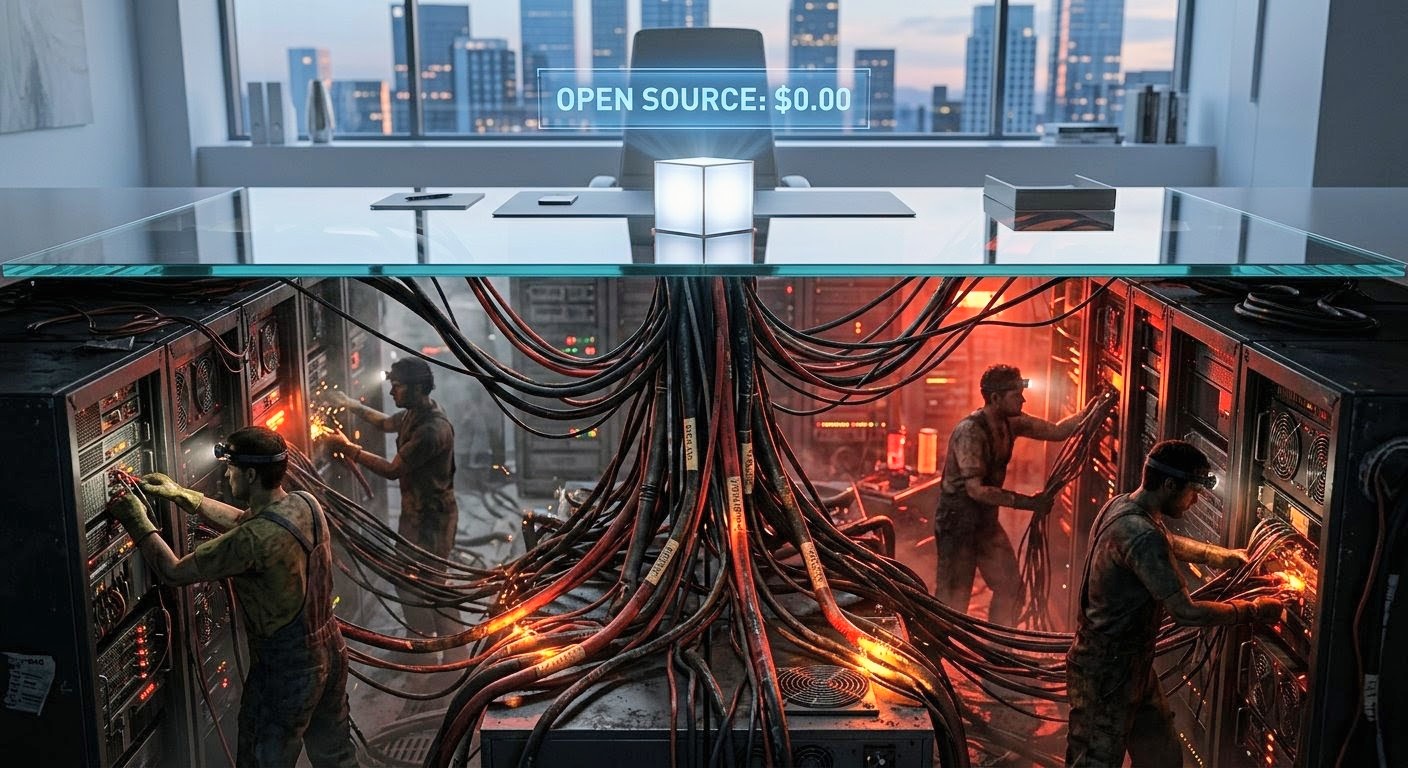
The Hook: The “Free Puppy” Fallacy
There is no such thing as free software in the enterprise. There is only software you pay for with an invoice, and software you pay for with your developers’ payroll.
I constantly audit agencies whose CTOs boast about their “zero-cost” open-source infrastructure. They’ve bypassed enterprise licensing fees by cobbling together an architecture of free GitHub repositories.
They are celebrating a rounding error while ignoring a hemorrhage.
When you adopt Open Source Software (OSS) to run your agency’s core operations, you aren’t getting a free tool; you are getting a free puppy. You don’t pay upfront, but you are now entirely responsible for feeding it, housing it, and paying the emergency vet bills when it inevitably gets sick. You traded a predictable $50,000 SaaS contract for a $180,000 DevOps engineer whose sole job is keeping your “free” infrastructure from collapsing.
The Market Context: The Contaminated Supply Chain
Why is the romanticized view of open-source a critical liability right now?
- The AI-Generated Contagion: In 2026, the velocity of code generation has broken the open-source review model. Malicious actors are using AI agents to flood popular repositories with thousands of seemingly benign pull requests that actually contain deep, obfuscated vulnerabilities. The unpaid volunteers maintaining these projects cannot mathematically keep up.
- The “Maintainer Burnout” Crisis: The digital infrastructure of the global economy is resting on the shoulders of a few hundred exhausted, unpaid developers. We are seeing a massive spike in “abandonware” or, worse, exhausted maintainers selling their repository rights to anonymous buyers who immediately inject spyware into the next update.
- The Rise of the SBOM Mandate: Following the supply chain attacks of the last three years, enterprise clients and government contracts now demand a Software Bill of Materials (SBOM). If your agency cannot instantly prove that your custom-built marketing stack is free of a newly discovered zero-day OSS vulnerability, you lose the pitch.
The Core Analysis: The TCO (Total Cost of Ownership) Reality
As a strategist, you must stop looking at the price tag and start looking at the Total Cost of Ownership. Here is why your open-source stack is draining your EBITDA.
1. The “Dependency Tree” Liability
You never just install one open-source tool.
- The Problem: You adopt a free analytics script. That script relies on 40 other open-source libraries, which rely on 200 more. You have just invited 240 unvetted, third-party developers into your client’s data pipeline.
- The Strategy: Security is no longer about building a perimeter; it is about supply chain management. If you are using OSS, you must deploy automated dependency scanning that physically blocks deployments if a nested library fails a real-time security audit.
2. The SLA Void (Service Level Agreement)
”Community Support” is not a business strategy.
- The Problem: It’s Black Friday. Your client’s e-commerce data pipeline, built on a free, self-hosted open-source message broker, crashes. With Enterprise SaaS, you have a dedicated account manager, an SLA, and financial recourse. With OSS, your lead engineer is frantically posting in a Discord channel, hoping a volunteer in Estonia is awake to help them debug the core logic.
- The Reality: The money you saved on licensing is instantly wiped out by the churn of one furious enterprise client.
3. The “Version Lock” Trap
Open source moves fast, but enterprise moves slow.
- The Problem: You built a custom CRM interface using an open-source framework. Two years later, the community releases a massive, non-backwards-compatible update (a “breaking change”). Your version is now officially deprecated and no longer receives security patches.
- The Execution Cost: You now have to halt all new feature development and spend three months paying your engineering team to refactor your entire codebase just to maintain the status quo.
Strategic Takeaway: The “Enterprise-First” Mandate
What is your move for tomorrow morning?
Stop letting your engineers make financial decisions based on their preferred tech stack. Execute a “TCO & Liability Audit”:
- The “Bus Factor” Check: Audit the core open-source tools your agency relies on. Look at the GitHub repository. If the project relies on one or two core contributors (a Bus Factor of 1), it is an unacceptable business risk. Rip it out.
- Shift to Managed Open Source: You don’t have to abandon OSS entirely, but you must stop self-hosting it. If you love an open-source database or CMS, pay the original creators (or AWS/Google Cloud) for the Managed Enterprise Tier. You get the open-source code, but you buy an SLA, automated patching, and a throat to choke when things break.
- Establish a Software Bill of Materials (SBOM): Mandate that your CTO implements an automated SBOM generator for every application your agency builds for clients. You must know exactly what invisible ingredients are in your software before your client’s compliance team asks.
In 2026, agility is the ultimate currency. If your top talent is busy patching free software, they aren’t building revenue-generating products.